

Artist: John Trumbull
Year: 1786
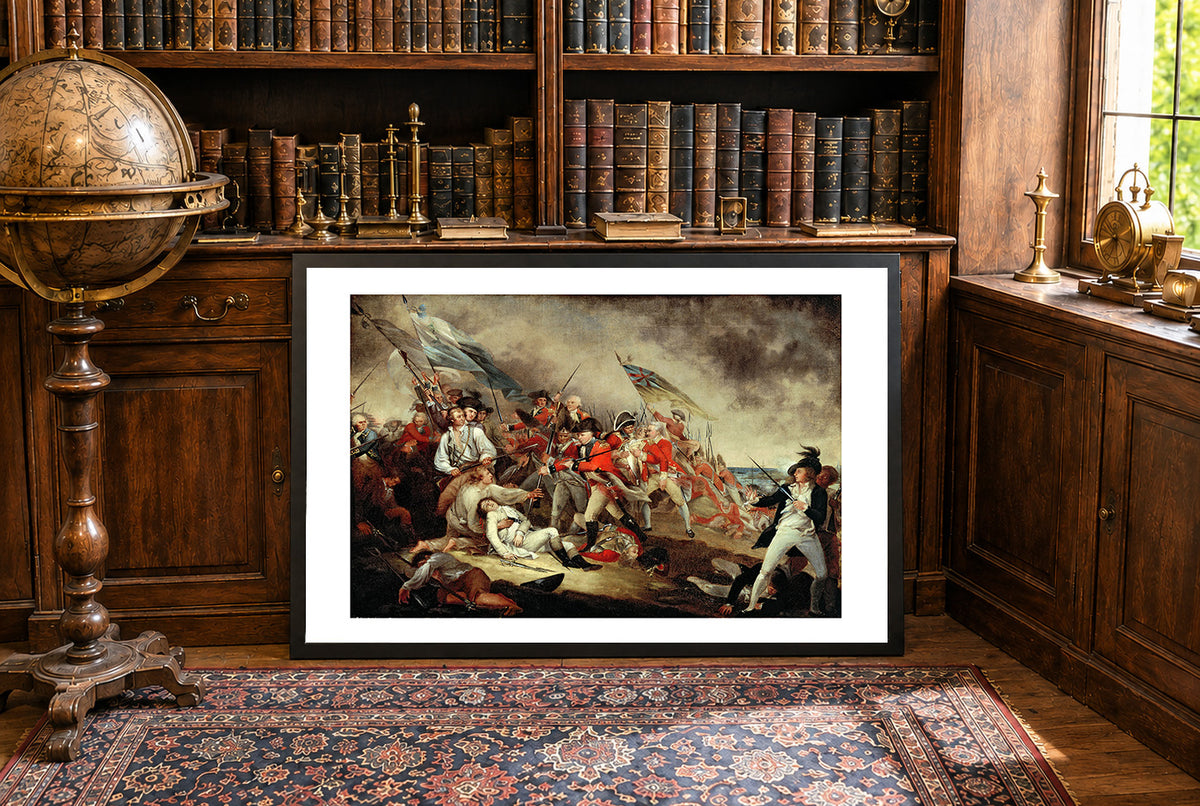
This is a reproduction print of the historical painting “The Death of General Warren at the Battle of Bunker's Hill, June 17, 1775”, created by American artist John Trumbull in 1786. One of the most celebrated paintings of the American Revolutionary War, the artwork depicts the death of Dr. Joseph Warren during the Battle of Bunker Hill on 17 June 1775, one of the earliest major engagements between American colonial forces and the British Army. The original 1786 painting is housed at the Yale University Art Gallery in New Haven, Connecticut.
The dramatic composition portrays Joseph Warren falling during the final British assault on the American defensive positions outside Boston. Warren, a prominent Massachusetts patriot leader who had recently been appointed a major general, chose to fight alongside the colonial militia as a volunteer. At the center of the scene, American soldiers attempt to protect his body as British troops advance. Among the recognizable historical figures are British Major John Small and American General Israel Putnam, whose presence contributes to the painting's narrative of courage and sacrifice.
Trumbull's painting is distinguished by its dramatic arrangement of figures, expressive gestures, detailed military uniforms and powerful contrasts of light and shadow. The artist presents the death of Warren as a tragic and heroic moment, emphasizing the personal cost of the struggle for American independence. British redcoats, colonial militiamen, bayonets and clouds of battlefield smoke create an intense composition that combines historical portraiture with the visual language of Neoclassical history painting.
Executed in oil on canvas, the 1786 version measures approximately 50.2 × 75.6 cm. Trumbull, who served in the Continental Army during the Revolutionary War, devoted much of his artistic career to documenting the events and leading figures of American independence. Although British forces captured the American positions at Bunker Hill, they suffered heavy casualties, and the battle became an enduring symbol of colonial resistance. This painting remains one of the most important visual representations of the American Revolution and the early struggle for United States independence.