

Artist: Nicolas Poussin
Year: c. 1640
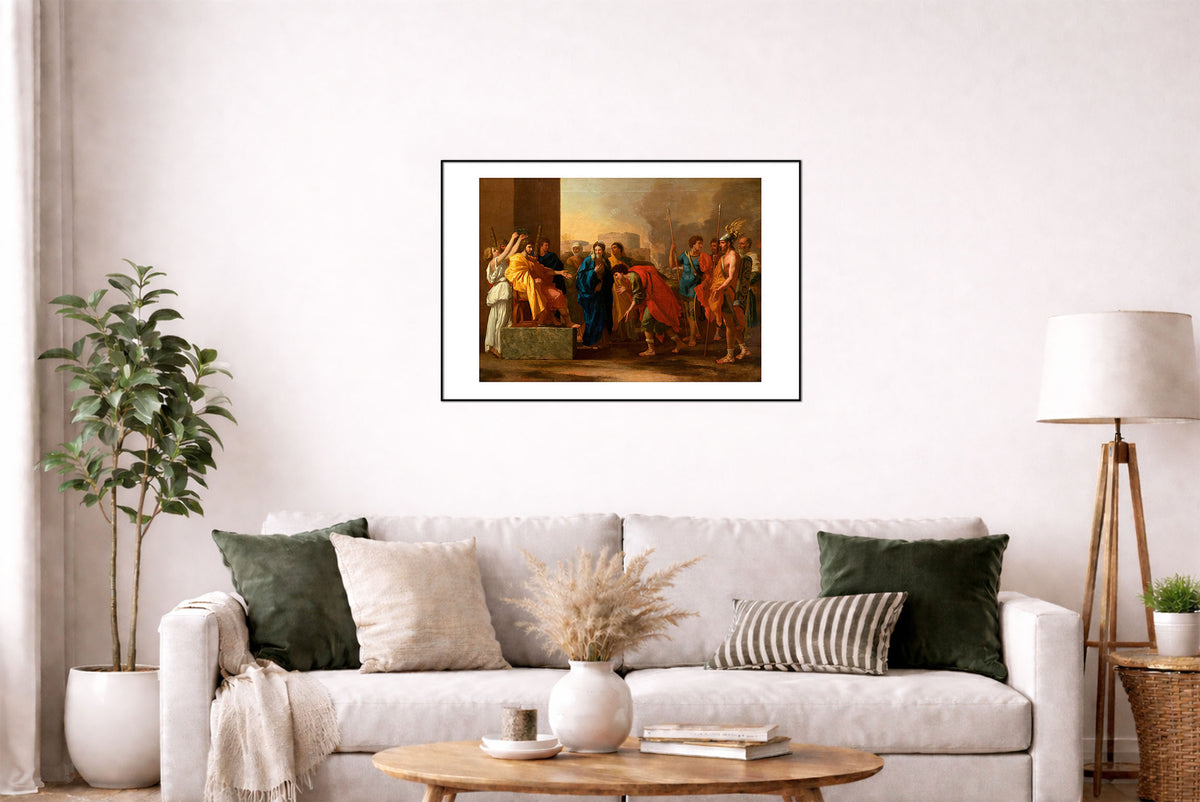
This is a reproduction print of the historical painting “The Continence of Scipio” (La Continence de Scipion), attributed to French Baroque painter Nicolas Poussin. The artwork illustrates a celebrated episode from ancient Roman history involving Publius Cornelius Scipio Africanus, the Roman general who later defeated Hannibal during the Second Punic War. Set after the Roman capture of New Carthage (Cartago Nova) in 209 BC, the scene portrays Scipio's remarkable act of restraint and generosity toward a young captive woman, presenting an enduring example of Roman virtue, honor and moral leadership.
According to the ancient historians Livy and Polybius, following the capture of the Carthaginian stronghold in Hispania, a beautiful young woman was brought before Scipio as a captive. Learning that she was betrothed to a Celtiberian nobleman, traditionally identified as Allucius, Scipio chose to return her unharmed to her family and fiancé rather than claim her as a prize of war. He also presented the gold offered as her ransom as a wedding gift. The episode became one of the most celebrated examples of the Roman ideal of continentia, or self-control, demonstrating the importance of moderation and justice in the exercise of military power.
The painting presents this encounter through a carefully organized classical composition, expressive gestures and a dignified arrangement of figures. Scipio appears as the central figure of authority, surrounded by soldiers, attendants and the young woman's companions. The contrast between the victorious Roman commander and the vulnerable captives emphasizes the moral significance of his decision. The classical costumes, architectural elements and measured expressions reflect the artistic ideals associated with Poussin's interpretation of ancient history, in which individual actions communicate broader lessons about virtue and human character.
Executed in the tradition of 17th-century French classical painting, the work reflects the Renaissance and Baroque fascination with the moral examples of ancient Greece and Rome. The story of Scipio's clemency became a popular subject among European painters because it offered an alternative to conventional images of military conquest, celebrating mercy, restraint and generosity rather than violence. “The Continence of Scipio” remains a compelling representation of the Second Punic War, the Roman Republic and the ethical ideals that shaped European historical art.